TL;DR
- Wet spots, soft flooring, and low water pressure are the three earliest warning signs of RV plumbing failure.
- Florida's heat and humidity accelerate pipe degradation faster than most states, especially near Stuart's coastal air.
- Ignoring early signs can turn a $150 fitting repair into a $1,800 water damage restoration.
- Common RV plumbing repairs range from $85 for minor fixes to $1,800 for full system overhauls.
- Treasure Coast RV Repair offers free on-site estimates. Call (772) 677-1583 to book a diagnostic visit.
The signs you need RV plumbing work usually show up long before a full-blown leak soaks your floor. Low water pressure, a rotten egg smell near the water heater, unexplained wet spots under your rig, or a toilet that won't hold water are all telling you something's wrong. The challenge is knowing which signs mean "call today" and which ones can wait a week. We've handled over 4,100 RV repairs since Danny Vasquez founded Treasure Coast RV Repair in 2013, and we see the same pattern every summer in Stuart: a small plumbing symptom gets ignored, the Florida heat does its thing, and what started as an $85 fitting fix becomes a multi-day repair.
This guide walks you through the warning signs by severity, explains what's actually happening inside your plumbing system, and tells you exactly what you're risking by waiting. Whether you're parked at a campground near Jonathan Dickinson State Park or storing your rig in Stuart, these are the signals you don't want to miss.
Early Warning Signs of RV Plumbing Problems (Don't Ignore These)
Early-stage plumbing problems are almost always fixable for under $200 if you catch them in time. The three signs we see most often at this stage are inconsistent water pressure, small drips at fittings or connections, and a toilet that slowly loses its water seal between uses. None of these feel urgent, but each one means something specific about what's failing inside your system.
Inconsistent pressure usually points to a failing water pump or a partial blockage in your fresh water lines. A toilet that won't hold water typically means the ball seal or valve seat has worn out, which is a straightforward repair that costs $85 to $250 depending on the model. Drips at PEX pipe fittings are common after temperature swings, especially after a Stuart summer where daytime temps routinely hit the low 90s and then drop significantly at night. That expansion and contraction works fittings loose over time.
The key at this stage is not to pressure-test yourself into more damage. If you crank up your pump trying to "see if it fixes itself," you can blow a fitting that was just barely holding.
Mid-Level Warning Signs: When Waiting Starts Costing You Money
If you've moved past the early signs and you're now seeing water stains on cabinets or walls, soft or spongy flooring near the bathroom or kitchen, or a water pump that cycles on and off when no fixtures are open, you're in mid-level territory. These symptoms mean moisture has already moved beyond the pipe or fitting and has started working on your RV's structure. In Florida's humidity, that process accelerates fast.
A pump that short-cycles (turns on by itself every few minutes with no faucets running) almost always signals a leak somewhere in the pressurized system. The pump is sensing pressure drop and compensating. Left alone, this runs your pump motor into the ground and keeps feeding water to wherever the leak is. We've seen Stuart-area rigs where a $150 fitting repair turned into a $900 job because the pump ran for weeks unattended and soaked a full section of subfloor.
Soft flooring is the sign that gets people most. Delamination, which is the separation of the floor's laminate layers due to moisture intrusion, often starts under the toilet or near the water heater bay. Once delamination sets in, you're no longer just fixing plumbing. You can read more about that process in our post on RV water damage and Florida humidity.
Why PEX Pipe Fails Faster in Florida
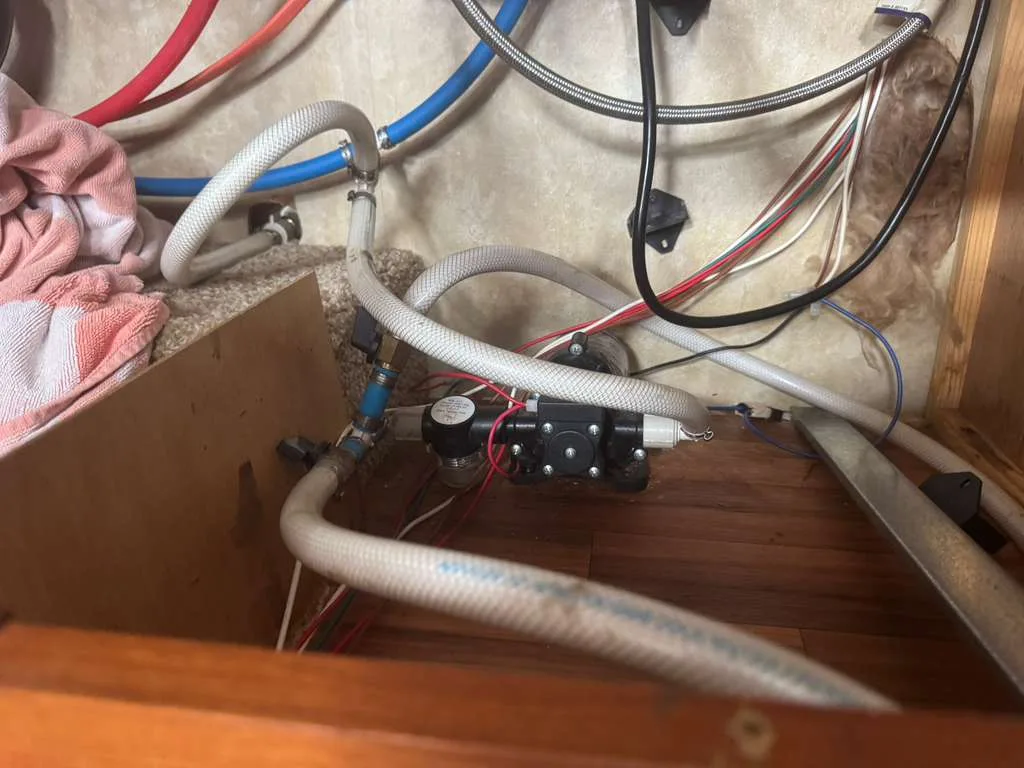
PEX pipe (cross-linked polyethylene) is the flexible tubing used in most modern RV plumbing systems. It handles expansion well, but Florida's UV exposure and consistent heat can make it brittle over time, especially in sections routed near slide-out mechanisms or exterior bays. We replace PEX runs regularly on Stuart-area rigs that are 7 to 10 years old, even when the owners haven't noticed a visible leak yet. A cracked PEX line often starts as a pinhole that only weeps under pump pressure.
RVIA guidelines call for PEX runs to be protected from direct UV contact, but in practice many manufacturers route sections through areas that see indirect sunlight for hours a day. Martin County's sun intensity makes that a real concern. If your RV is more than eight years old and you haven't had the plumbing inspected, it's worth a diagnostic visit before next season.
Pro Tip: The Paper Towel Test
Run your water pump up to pressure, then shut off the water supply valve and watch your pressure gauge. If pressure drops more than 5 PSI in two minutes, you have a leak somewhere in the system. Walk each accessible fitting and pipe section with a dry paper towel pressed to the connection. Even a pinhole will leave a wet spot on the paper. This is the same basic method our technicians use as a first diagnostic pass, and it costs you nothing to try before calling.
Severe Warning Signs: Stop Using the Water System Now
Some symptoms mean you should stop using the plumbing entirely until the rig gets looked at. These include visible sewage smell inside the cabin (not just near the dump connection), black or brown water coming from your fresh water taps, a water heater that makes popping or rumbling sounds, and any sign of water pooling under the coach after a normal use day. Each of these points to a failure that's actively getting worse every time you use the system.
A water heater that pops and rumbles usually has significant sediment buildup in the tank, which is common in South Florida where municipal water runs harder than in other regions. That sediment traps water beneath it, causes localized boiling, and can eventually crack the tank lining. A water heater replacement runs $400 to $900 depending on whether you're replacing a standard tank unit or upgrading to a tankless system. Catching it at the sediment stage means a flush and inspection for around $150. Waiting until it cracks means a full replacement.
Black or brown water from your fresh taps is a contamination sign and almost always means your fresh water tank or lines need immediate sanitization. Per NFPA 1192 standards, RV fresh water systems are supposed to maintain potable water quality. If yours isn't, that's a health issue, not just a mechanical one. Our team handles fresh water sanitization as part of our plumbing service lineup.
| Service | Estimated Cost | Urgency Level |
|---|---|---|
| Toilet seal / valve repair | $85 – $250 | Low to Medium |
| Water pump replacement | $150 – $400 | Medium |
| PEX pipe repair or section replacement | $150 – $500 | Medium to High |
| Fresh water sanitization | $85 – $200 | High (health risk) |
| Water heater flush and inspection | $85 – $200 | Medium |
| Water heater full replacement | $400 – $900 | High |
| Holding tank repair or reseal | $200 – $600 | High |
| Full plumbing system diagnostic | $85 – $150 | Any stage |
| Water damage + plumbing restoration | $600 – $1,800 | Severe |
Pricing Disclaimer
All prices shown are estimates based on national averages and our service history. Actual costs may vary depending on current market conditions, parts availability, your specific RV model, and the scope of work required. The only way to determine your final cost is through an on-site diagnosis by our certified technician. Call (772) 677-1583 for a free estimate.
Florida-Specific Factors That Speed Up RV Plumbing Failure
Stuart and the wider Treasure Coast sit in one of the most demanding environments for RV plumbing in the country. You've got salt air from the St. Lucie Inlet working on metal fittings and water heater anodes, consistent heat that keeps your rig's interior temperature elevated even when parked, and humidity levels that rarely drop below 70 percent. That combination breaks down plastic fittings, accelerates corrosion on copper connections, and keeps any existing moisture from drying out naturally.
Martin County's water supply also runs with relatively high mineral content, which means more scale buildup inside water heaters and on pressure regulators. We recommend annual water heater anode rod inspections for any rig stored or used regularly in this area. An anode rod replacement costs $85 to $150 and can double the life of your tank. Skipping it regularly is one of the fastest ways to turn a long-lived water heater into a $700 replacement job.
UV exposure here is also more intense than most RV owners from northern states expect. Exterior plumbing components like city water entry fittings, filter housings, and exterior shower connections see direct sun for eight to ten hours a day during summer. That kind of UV load degrades plastic components within three to five years. We factor all of this into our diagnostics when we're working on rigs in Stuart and the surrounding communities.

What a Professional Diagnostic Covers
When our team arrives for a plumbing diagnostic, we're not just looking for the obvious drip. We pressure-test the entire fresh water system, inspect every accessible fitting and pipe run, check the water heater anode and thermostat, test pump pressure and cycle behavior, and inspect holding tank connections and vent lines. Danny Vasquez built our diagnostic process around the kinds of failures we see most often after 13 years of working on Treasure Coast rigs, and that experience shows in how quickly we find problems other shops miss.
A full diagnostic runs $85 to $150 and gets credited toward any repair work we complete. For a look at how that fits into broader repair costs, our Treasure Coast RV repair cost guide breaks down what different service categories typically run in this market.
Real Scenarios We See Every Summer in Stuart
Here's what a typical progression looks like. An owner notices their water pump runs a few extra seconds after they turn off the faucet. They figure it's normal. By the next month, the pump is short-cycling every eight minutes. They add air to the accumulator tank, which helps briefly. By the time they call us, there's a pinhole in a PEX elbow behind the bathroom wall and the wall panel has been damp for six weeks. The PEX repair is $200. The panel drying and mold treatment adds another $350. Total: $550. If they'd called at the first short-cycle, we're talking $150 and an hour of work.
We also see a lot of water heater failures that arrive as "it just stopped getting hot." About 40 percent of those are a failed thermostat or heating element, which runs $85 to $200 to fix. The other 60 percent have a cracked tank from years of sediment buildup, and those need full replacement. The difference between the two outcomes is usually one annual flush. For context on preventing that kind of failure long-term, our post on RV water damage in Florida covers the full picture of moisture-related failures in this climate.
Our RV plumbing service covers all of these scenarios. We're RVIA certified, licensed, bonded, and insured, and we serve 16 cities across St. Lucie, Martin, and Indian River counties. If something in this guide sounds familiar, the best next step is a phone call to (772) 677-1583 for a free estimate.
Questions about rv plumbing on the Treasure Coast? Call (772) 677-1583 and ask for Danny. Free estimates, same-day service available.